
Why Waldorf Education Works in an AI World
For decades, movies and TV shows imagined a future filled with talking robots, flying cars, and machines that could think for us. The flying cars have not quite arrived, but the thinking machines have, and they are already reshaping how we search, write, learn, create, and make daily decisions.
For schools, this raises an important question: how do we prepare students for a world where answers can be generated almost instantly?
In Waldorf education, the answer is to acknowledge AI exists, while also taking a slower, more intentional approach to using it. Before students rely on powerful tools, they need to build the human capacities those tools cannot replace: critical thinking, creativity, judgment, focus, memory, ethical reasoning, and the ability to make meaning from lived experience.
AI as a Tool, Not a Substitute for Thinking
A growing concern around AI is its increased function in cognitive offloading. Cognitive offloading happens when we hand mental tasks over to an outside tool. This is not always bad! Humans have always used tools to extend our thinking, from notebooks and calendars to calculators and maps. A recent article in Frontiers in Psychology notes that AI can reduce mental effort in helpful ways, such as organizing information, supporting reflection, or easing decision fatigue. But the same article also warns that when AI begins to replace internal effort, it can weaken the very capacities it is meant to support. The authors describe the key distinction as whether AI functions as a scaffold or a substitute. A scaffold strengthens the learner. A substitute does the work on the learner’s behalf.
That distinction is central to Waldorf education. The goal is not for students to produce a finished answer, essay, or project. The goal is for students to become more capable through the process of getting there.
A Harvard Gazette article on AI and critical thinking makes a similar point. Harvard lecturer Dan Levy explains that if students use AI to do the work for them, rather than with them, “there’s not going to be much learning.” He argues that the assignment itself is not the ultimate goal; it is the vehicle through which learning happens.
That idea becomes even more important as AI changes the role students may play in future education structures. In a Harvard forum, titled “Thinking in an AI-Augmented World, Anthea Roberts, CEO of the AI software Dragonfly Thinking, explains that by the year 2050, “where previously knowledge production was ‘the actor on the stage, the athlete on the field, the writer of the book,’” the next generation [of students] must be trained to orchestrate a team of AIs. “You become the director of the actor, you become the coach of the athlete, and you become the editor of the writer,” she said. But those roles still require “very strong faculties” of judgment, understanding, and discernment.
Healthy Skepticism Is a Future-Ready Skill
To prepare for AI, students also need more than technical fluency. They need healthy skepticism.
Healthy skepticism does not mean rejecting technology. It means being willing to pause and ask: Is this the right tool for the task? What is this answer based on? What might be missing? Whose perspective is included or excluded? Does this make sense? What do I think?
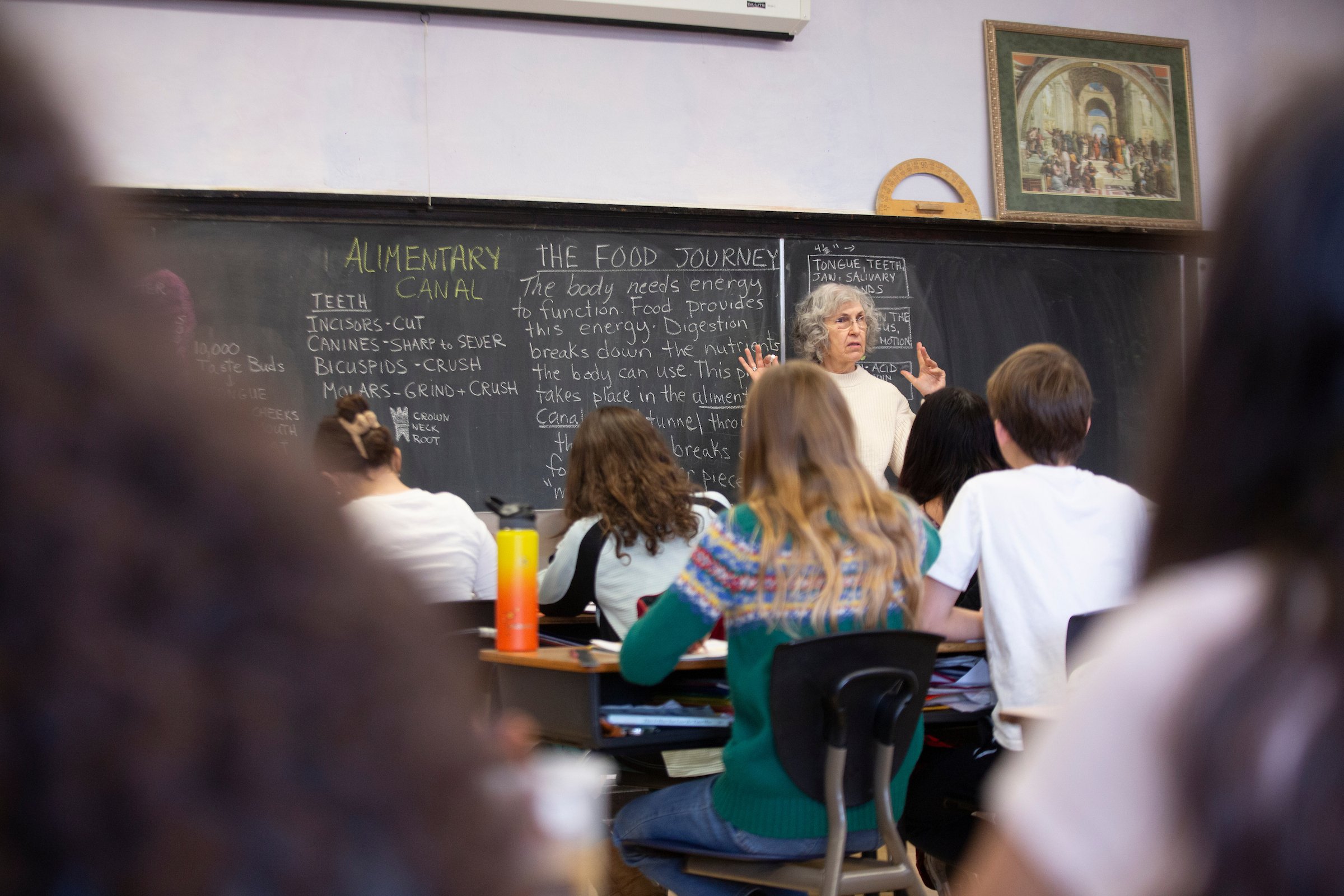
In Waldorf classrooms, students often learn through multiple pathways. They may explore a scientific concept through observation, drawing, measurement, and discussion. They may study history through biography, primary sources, writing, and debate. This layered approach helps students develop judgment. They learn that knowledge is not merely something to retrieve. It is something to test, question, connect, and make meaningful. Knowledge isn’t passively retrieved but actively formed.
Education researcher Tina Grotzer notes that many students use AI without understanding how it works, which can lead them to place too much confidence in its output. She emphasizes the importance of teaching students to be “critical and discerning” about what AI offers, while also helping them understand the power of their own embodied human minds.

A common misunderstanding is that Waldorf education is “anti-technology,” but Waldorf schools recognize that technology is part of modern life. Older students can and should learn how to engage with digital tools, research platforms, media, and emerging technologies. But the question is always developmental and purposeful: What tool serves the learning? What capacities are students ready to bring to it? Does the tool deepen understanding, or does it bypass it? Is it a substitute or is it a scaffold?
The question schools face now is not whether AI will be part of students’ futures. It will be. The question is whether students will meet AI as passive users or active thinkers.
In an age where technology can produce answers quickly, Waldorf education reminds us that the deeper work of learning still belongs to the student. And that may be exactly what the AI age requires most.